
Why Integrated Hospital Connectivity Matters?
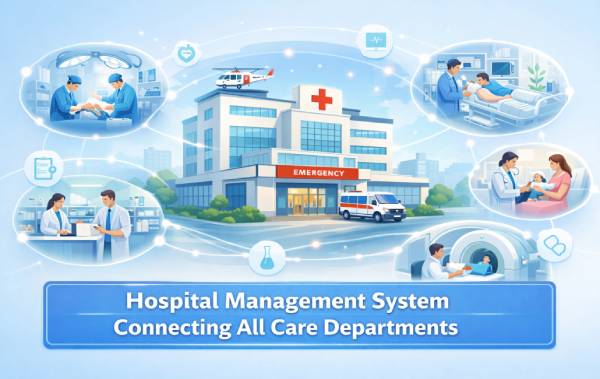
Modern healthcare delivery depends on how efficiently information moves across departments. A Hospital Management System (HMS) acts as the digital backbone of a hospital, connecting clinical, diagnostic, and administrative units through a centralized platform.
In multi-department healthcare environments, disconnected systems often lead to delays, duplicate work, billing errors, and patient dissatisfaction. An integrated hospital management system resolves these challenges by enabling real-time data sharing, streamlined workflows, and coordinated decision-making across all care departments.
Hospitals in India are increasingly adopting online hospital management systems to manage high patient volumes while maintaining accuracy, compliance, and service quality.
How a Hospital Management System Links All Care Units?
A comprehensive Hospital Management System Software enables seamless coordination among doctors, nurses, laboratory technicians, pharmacists, and administrative staff by providing a single source of truth.
When departments operate on the same system:
- Patient records update automatically
- Test orders flow directly to laboratories
- Prescriptions sync with pharmacy inventory
- Billing reflects real-time services delivered
This integration reduces manual intervention, improves clinical accuracy, and supports data-driven hospital operations. For Indian hospitals, particularly mid-to-large-scale facilities, such systems are critical to maintaining efficiency under increasing demand.
Comprehensive Hospital Connectivity Platform
Core Components of an Integrated Hospital Connectivity Platform
1. Centralized Digital Hospital Information System
At the heart of an HMS is a unified hospital information system that manages:
- Patient registration and demographics
- Appointment scheduling
- Clinical documentation
- Treatment histories
By consolidating these functions, the system ensures that every department accesses up-to-date and accurate patient information, improving continuity of care and operational efficiency.
2. Advanced Pharmacy Management Integration
An integrated pharmacy management module connects prescriptions directly with inventory and dispensing workflows. This enables:
- Accurate medication dispensing
- Automated stock monitoring
- Reduced prescription errors
- Faster fulfillment times
By eliminating manual coordination between clinicians and pharmacists, hospitals minimize delays and improve medication safety.
Also read: Private MRI Scans in the UK: Types, Benefits, and What to Expect
3. Laboratory Information and Diagnostics Management
Laboratory modules within a Hospital Management System manage:
- Test requests from clinicians
- Sample tracking
- Result validation and reporting
Once results are finalized, they are instantly available within the patient’s electronic record. This reduces turnaround time, supports faster diagnosis, and enables physicians to make timely clinical decisions.
4. Billing, Finance, and Insurance Claims Automation
A robust HMS integrates billing and finance workflows by automatically capturing chargeable services from every department. This includes:
- Consultation fees
- Lab investigations
- Pharmacy transactions
- Insurance claims processing
Automated billing reduces errors, improves financial transparency, and ensures accurate revenue tracking for hospitals.
Secure and Compliant Digital Healthcare Infrastructure
1. Secure Clinical Operations Management
Hospital Management System Software is designed with data security as a priority. Encrypted access controls ensure that patient records, schedules, and treatment data remain protected while still being accessible to authorized staff.
This balance between accessibility and security is essential for regulatory compliance and patient trust.
2. Patient Relationship and Engagement Systems
Integrated patient engagement modules support:
- Appointment reminders
- Follow-up scheduling
- Communication notifications
These features improve patient experience, reduce missed appointments, and increase overall satisfaction while maintaining data confidentiality.
3. Clinic and Workforce Administration Management
Clinic administration modules streamline:
- Doctor and staff scheduling
- Departmental workflows
- Operational reporting
Online access to these tools allows hospital managers to monitor performance, allocate resources effectively, and ensure smooth collaboration between departments.
4. EMR and EHR Data Integration
Electronic Medical Records (EMR) and Electronic Health Records (EHR) are central to coordinated care. An integrated HMS ensures that:
- Clinical notes
- Diagnostic reports
- Treatment plans
are securely stored and instantly available across departments. This supports continuity of care, reduces duplication, and enhances clinical accuracy.
Real-World Impact: Hospital Management System Implementation in India
Challenges Before Integration
Many hospitals in India face common operational challenges, including:
- Overcrowded outpatient departments
- Fragmented patient records
- Long waiting times
- Limited interdepartmental communication
Traditional, manual systems often slow down workflows and negatively affect both staff efficiency and patient experience.
Solution Through Integrated Hospital Management Systems
Hospitals that implemented a comprehensive Hospital Management System observed significant improvements after integrating modules such as:
- Online patient records
- Hospital queue management systems
- Real-time departmental dashboards
Departments began sharing data instantly, reducing delays, miscommunication, and repetitive data entry.
Measurable Outcomes and Benefits
After implementation, hospitals experienced:
- Reduced patient waiting times
- Improved accuracy in billing and diagnostics
- Better resource utilization
- Enhanced collaboration among medical and administrative teams
These outcomes demonstrate how an integrated HMS supports both operational excellence and quality patient care.
Future Outlook of Hospital Management Systems in Healthcare
The future of hospital management systems will focus on:
- AI-assisted diagnostics and predictive analytics
- Smarter hospital queue management
- Cloud-based platforms for scalable access
- Telemedicine and remote patient monitoring integration
- Increased interoperability with national health data systems
As healthcare delivery evolves, hospitals that invest in adaptable, integrated systems will be better positioned to meet patient expectations and regulatory requirements.
Final Thoughts
A modern Hospital Management System connects all care departments through a unified digital platform, enabling hospitals to operate efficiently while delivering high-quality patient care.
By integrating clinical, diagnostic, and administrative functions, hospitals gain real-time visibility into operations, improve decision-making, and enhance patient confidence. The growing adoption of hospital management software in India highlights its importance in creating sustainable, efficient, and patient-centric healthcare systems.