
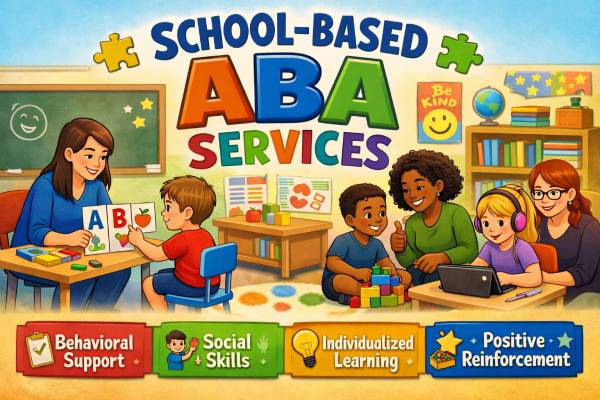
Schools provide a dual role as a seat for learning and development with regard to social and emotional capabilities for students. Students that are having difficulties in learning, communication, or behavior, which can be related to students that receive a diagnosis relating to ASD or other developmental challenges, require an extra level of support. The ABA services provided in schools are designed to meet this need for student success through evidence-based practices that utilize Applied Behavior Analysis.
The aim of this article is to explain how school-based ABA services support student learning and behavior, highlight their key components, and show why they are an important part of inclusive, high-quality, and effective educational practices.
What Do School-Based ABA Services Mean for My Child?
Applied Behavior Analysis (ABA) is an efficient technique in teaching children positive behaviors as well as acquiring fundamental skills by understanding the role of the environment in shaping them. ABA therapy involves teaching children positive habits like paying attention, proper communication, adhering to a daily schedule of routines, as well as breaking up negative habits that hinder the learning process of children.
The school-based services offer these support structures to your child at the same place that you take your child to school every day. This means that you no longer have to bring this ABA specialist into your house and use his services only while your kids are at home, but rather, ABA techniques are being used every day at school to help these kids use these strategies that were learned in real life.
These are done with the help of professionals like a Board Certified Behavior Analyst (BCBA) and other support staff in behavior. The end result of their combined endeavors, much like what you and the teacher do, will be that the child will be provided with a plan that could help him/her with his/her learning process at school.
Develop Academic Skills Using ABA
One of the major goals of delivering ABA services to school-going children is to ensure they have academic success. It is a known fact that students do not attain success in school not because they lack abilities to do well academically, but due to other factors.
Individualized Instruction
For school-based ABA services, they have to do with the use of assessments that are individualized to meet the different student needs. Then, they teach each student ways to break down complex academic skills, including the ability to read, write, etc.
Skill Acquisition and Generalization
Also, one of the major advantages or focuses of the ABA strategies is that the skills learned should be utilized or applied. For example, if a child learns how to follow an instruction, it is considered a skill, and especially if the child needs one-on-one assistance, then the skills should be utilized or applied in a group setting.
Increasing On-Task Behavior
Moreover, attention and engagement in tasks are key components in all forms of learning processes. In consideration of all this, from the setting of an ABA intervention program in a school environment, reinforcement strategies are utilized to enhance student engagement during class periods. This implies that the more a student engages in class, the more they may gain access to information and demonstrate all they can understand in academic contexts.
Also read: Hospital Management System Connecting All Care Departments
Improving Behavior in Educational Settings
Behavior challenges can be detrimental to the learning process, not only to the individual but also to their peers. ABA services in schools tackle these challenges on an individual basis, being proactive, supportive, and data-driven.
Functional Behavior Assessment (FBA)
One very important aspect relating to ABA programs, especially in a school, are the FBAs. FBA is an approach that helps identify the purpose of the behavior, the function of a particular behavior, or what the behavior is meant to achieve, attain, etc., like attention. The purpose of a particular behavior is important in effectively managing the behavior.
Positive Behavior Support Plans
Consequently, individual plans are generated based on the findings of the assessment, and as such, ABA professionals develop such plans. The purpose of the plan is the promotion of desirable behaviors as opposed to restricting undesirable behaviors. For instance, a student may exhibit disruptive behaviors, but with the intention of avoiding some homework, and the plan generated could be a means of asking for a break.
Consistency Across Environments
This being a school-based intervention for ABA services, this would be advantageous since the intervention strategies can be implemented on a wide scale throughout the classrooms, hallways, and other common areas. This would be crucial for the student’s understanding of the change and the intervention strategy.
Developing Social and Communication Skills
Social interaction is an important aspect in the school setting, and learning challenges could affect both social learning and academic learning. The ABA interventions in the school system aim at teaching skills that are hard to learn naturally.
Peer Interaction and Social Play
ABA can help students to learn skills such as playing with others, making conversations with others, and sharing with others. Learning such skills in real life and directly with the students will be helpful to them.
Communication Support
In cases where one is working with someone with limited verbal skills and delayed language development, other forms of communication can additionally be involved in school-based interventions of ABA therapy. This may include either picture communication systems, visual supports, and even AT devices. There is consequently a reduction in cases of frustration:
Collaboration With Educators and Families
Furthermore, the idea of ABA states that one of the fundamental benefits of ABA school services is collaboration. In fact, it is not possible to devise an efficient ABA program without collaboration.
Teacher and Staff Collaboration
There are chances that professionals in ABA work with these teachers with the intention of establishing congruence between strategies used to manage behavior and academic goals. There are also chances that they do offer training, modeling, and feedback to these teachers to ensure that they implement strategies used to manage behavior with confidence and assurance.
Family Involvement
The role of the family is important for the success of the ABA program. It is, therefore, established that effective communication between the school and the family could result in the generalization of skills in the long term.
Promoting Inclusion and Independence
The ABA services provided with regard to their setting in school could be said to be helpful for inclusion because it facilitates access for students to a general education setting whenever appropriate by providing assistance with learning and behavioral issues to access a classroom with their friends.
The end goal will be to make them more independent. As the students become more proficient in the desired areas, more cloak-like supports can be removed to help them successfully manage their own actions and learning.
The Long Term Impact of School-Based ABA Services
Studies and research have always affirmed the effectiveness of ABA interventions. In particular, when it comes to the support of academic, behavioral, and social development, the efficacy of ABA interventions has been confirmed. When the interventions are well implemented in the school program, it can impact a number of students. In particular, it has a greater impact on the teacher, mainly due to the impact of positive behavior.
Equally, school-based ABA services may facilitate students’ readiness for a successful future by helping them acquire some key skills such as problem-solving skills, communication skills, and self-management skills, among others, which are significant outside the school context.
Conclusion
The application of ABA services, which are applicable in schools, entails important services, particularly concerning learning as well as behaviors. The direct application of ABA techniques to the school environment is important as it enables students to be relieved from various impediments to their learning, while also aiding in the acquisition of appropriate behaviors.
Other than these, individual instruction and the focus on issues concerning inclusion/independence in a school-based ABA program have also significantly contributed to a more conducive and positive attitude towards inclusion by providing the student with a more supportive and more positive school experience. As part of a push for student success, the position and role of ABA have found their place as part of a larger student-centric system.